
The Role of Nurse Practitioner Diversity in Expanding Care Access in California Fact Sheet
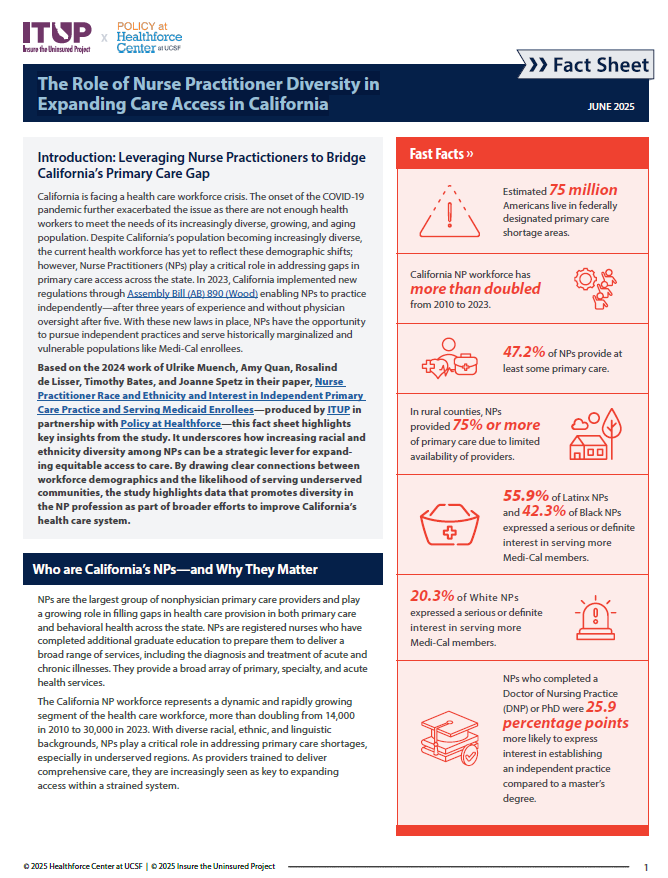 California is facing a critical health care workforce crisis. Nurse Practitioners (NPs) are uniquely positioned to help close these gaps in primary care access—especially in underserved and historically marginalized communities. With the passage of Assembly Bill (AB) 890 (Wood) in 2023, California opened new doors for NPs. Under this law, NPs with three years of clinical experience can now practice independently, and after five years, they may do so without physician oversight. This shift empowers NPs to expand their reach and establish independent practices that can serve Medi-Cal enrollees and other vulnerable populations.
Based on the 2024 work of Ulrike Muench, Amy Quan, Rosalind de Lisser, Timothy Bates, and Joanne Spetz in their paper, Nurse Practitioner Race and Ethnicity and Interest in Independent Primary Care Practice and Serving Medicaid Enrollees—produced by ITUP in partnership with Policy at Healthforce—this fact sheet highlights key insights from the study.
It underscores how increasing racial and ethnicity diversity among NPs can be a strategic lever for expanding equitable access to care. By drawing clear connections between workforce demographics and the likelihood of serving underserved communities, the study highlights data that promotes diversity in the NP profession as part of broader efforts to improve California’s health care system.
This ITUP Fact Sheet was developed in collaboration with the Healthforce Center at UCSF.